


Dental Anxiety? Here's How Happy Gas Makes Dentist Visits Stress-Free
Updated: May 25
If you've ever cancelled a dental appointment because the thought of sitting in the chair felt like too much, you're not alone. Dental anxiety affects a significant portion of the Australian population, and for many people it's not a minor inconvenience. It's the reason they put off care for months or years, until a small problem becomes a serious one.
At Aminya St Dental in Mansfield, Brisbane, we see anxious patients every day. We've been doing this for over 40 years, and one thing we know for certain is that your fear is valid, and it's something we can work with. One of the most effective tools we have for nervous patients, both adults and children, is happy gas (Relative analgesia). This article explains everything you need to know about it
What is happy gas?
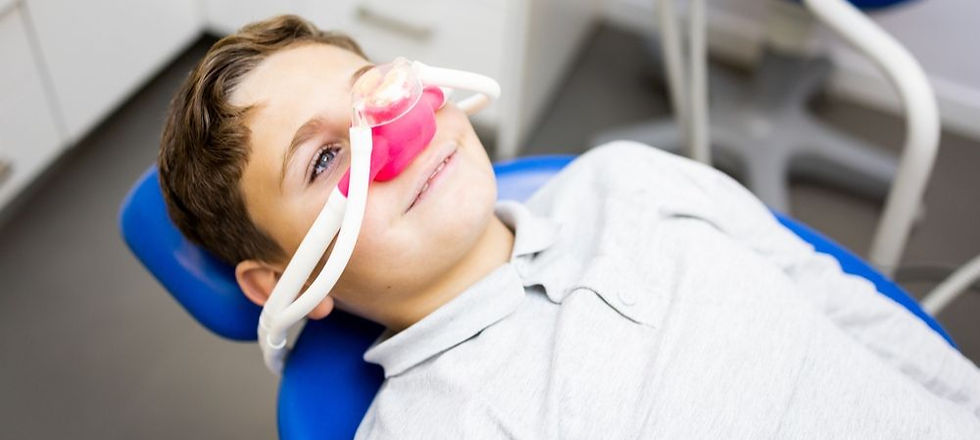
Happy gas is the common name for nitrous oxide, a colourless, odourless gas that has been used safely in dentistry for decades. At Aminya St Dental, it's administered as a carefully controlled mixture of nitrous oxide and oxygen, delivered through a small, soft mask that sits over your nose.
Within a few breaths, most patients begin to feel noticeably calmer. You remain fully conscious throughout, you can speak, respond, and signal to the dentist at any time. It is not a general anaesthetic, and it won't put you to sleep. The primary effect is simply a sense of ease and relaxation.
Once the mask is removed, the gas clears your system within minutes because it is only weakly absorbed by the body. There is no lingering grogginess the way there is after stronger sedation.
What does happy gas feel like?
The experience typically begins within two to three breaths. You may notice a slight warmth spreading through your body, a gentle tingling in your hands and feet, and a light-headed sensation similar to the feeling just before you fall asleep. Sounds around you may seem slightly softer or more distant.
What most patients report afterwards is not that they felt nothing, but that they didn't feel worried. The treatment happened, and it was fine. That shift from dreading every step to simply getting through it is what makes happy gas preferred by so many people.
Which dental procedures can happy gas be used for?
Happy gas can be used across a wide range of general dental treatments. At Aminya St Dental, it's available for:
Routine check-ups and cleans for patients who feel significant anxiety even during standard appointments
Tooth fillings and restorations
Tooth extractions, including straightforward wisdom tooth removals
Root canal treatment
Periodontal (gum) therapy
Children's first dental appointments
Any procedure where needle anxiety is the primary barrier
It's worth being honest about its limits: happy gas softens anxiety and reduces discomfort, but it is not a replacement for local anaesthetic when an area needs to be fully numbed. For most procedures, your dentist will use both. The happy gas settles you, and the local anaesthetic handles the pain. For very lengthy or surgically complex procedures, your dentist will discuss whether a stronger form of sedation is more appropriate.
Is happy gas safe?
Happy gas has one of the longest safety records of any sedation method used in dentistry. When administered by trained dental professionals at clinically approved concentrations, it is considered very safe for both adults and children.
A few points worth knowing:
It is delivered via a calibrated machine that maintains a precise, safe ratio of nitrous oxide to oxygen at all times
You receive continuous oxygen throughout the procedure, your oxygen levels are never compromised
Side effects are uncommon. The most frequently reported issue is mild nausea, and this tends to occur only at higher concentrations or when the flow rate is adjusted repeatedly
It clears your body within minutes of the mask coming off, with no residual sedative effect for the vast majority of patients
If you are pregnant, always inform the dentist before any appointment, they will advise whether happy gas is appropriate during your stage of pregnancy
Can you drive home after happy gas?
This is one of the most searched questions on this topic, and the answer varies depending on who you ask. Here is the accurate position: in most cases, yes, patients can drive approximately 15 to 20 minutes after the mask is removed and pure oxygen has been administered to flush the gas from their system.
However, your dentist at Aminya St Dental will confirm this individually before you leave. If you feel any residual lightheadedness, tingling, or unusual sensation, do not drive. Arrange for someone to collect you, or wait until you are fully clear.
This is a meaningful advantage over IV sedation, which requires a responsible adult escort to and from the clinic and typically a monitoring period before discharge.
Happy gas vs IV sedation - which is right for you?
Both are legitimate options for anxious dental patients, but they serve different situations.
Happy gas is generally the right choice when:
Your anxiety is mild to moderate
The procedure is routine or relatively short
You want to be able to drive home afterwards
You want to avoid needles to initiate sedation (happy gas requires no injection to begin working)
You'd like to stay aware and communicative during treatment
IV sedation is more appropriate when:
Anxiety is severe and happy gas alone may not provide sufficient relief
The procedure is lengthy or complex
A deeper level of sedation is clinically indicated
At Aminya St Dental, the decision is always made on a case-by-case basis, taking into account your medical history, the procedure planned, and your personal comfort level. There is no one-size-fits-all answer, and the team will discuss the right option with you without pressure.
Happy gas for children - what parents need to know
Children respond particularly well to happy gas. It removes the cycle of fear that can develop when a child has a difficult early dental experience and it means the dentist can work more effectively without the child needing to be rushed or held still.
If your child is having happy gas for the first time, here is what to tell them beforehand:
They'll wear a small nose mask that may smell faintly sweet
They might feel a bit floaty or giggly and that's completely normal
They can talk to the dentist the whole time
It will be over quickly and they'll feel back to normal very soon after
A few practical notes for parents: avoid giving your child a heavy meal in the two hours before the appointment, as a full stomach can contribute to nausea. Light eating beforehand is fine.
Aminya St Dental has been seeing children for decades. Dr. Steven Fiore received academic prizes specifically in paediatric dentistry during his training at the University of Queensland School of Dentistry, and the whole team is experienced in making young patients feel comfortable from the first visit.
"I tried happy gas before and it didn't work" - what that means
If a previous experience with happy gas felt ineffective, if you felt little to no difference, there are a few possible explanations. The concentration used may have been lower than what your anxiety level required. More commonly, many patients breathe through their mouth when nervous, which largely bypasses the effect of a nose mask entirely. If you were anxious and mouth-breathing, the gas may not have had the chance to work properly.
At Aminya St Dental, the team takes time before beginning any treatment to ensure the patient is fully settled and breathing through the nose as intended. The flow rate is adjustable, and the dentist will confirm you are feeling the effects before proceeding. A previous ineffective experience does not mean happy gas will not work for you, it may simply mean it wasn't given the right conditions to do so.
Does private health insurance cover happy gas?
Happy gas is not covered by Medicare. Whether your private health fund covers it depends on your specific level of extras cover - some funds include it under general anaesthesia or sedation item numbers, while others do not.
Aminya St Dental offers HICAPS on-the-spot claiming, which means you can check your rebate entitlement immediately at the time of your appointment. If you want to know before you come in, call your health fund directly and ask about coverage for nitrous oxide sedation (sometimes listed under item number 916 or similar), policies vary considerably between providers.
How to request happy gas at Aminya St Dental, Mansfield
Simply mention it when you book your appointment - by phone on (07) 3349 7749 or through our online booking system. The team will note it on your file so everything is prepared when you arrive. No special pre-appointment preparation is required beyond informing us of any relevant medical history or medications.
If you're not sure whether happy gas is the right option for you, that's a conversation you can have at the appointment itself. There's no obligation to proceed with anything until you feel comfortable. View more of our services.
Frequently asked questions about happy gas
Does happy gas put you to sleep?
No. Happy gas is a form of conscious sedation where you remain fully awake and responsive throughout. You will be aware of what is happening around you; you simply won't feel distressed by it.
Is happy gas safe for children?
Yes. Happy gas is widely used in paediatric dentistry and is considered very safe when administered by trained dental professionals. It is one of the most common ways to help anxious children through dental treatment.
How quickly does happy gas work?
Most patients begin to feel the effects within two to three breaths. Full effect is typically reached within five minutes.
Can I drive after happy gas?
In most cases, yes, approximately 15 to 20 minutes after the mask is removed and pure oxygen has been given. Your dentist will confirm this individually before you leave.
Does happy gas stop pain completely?
Happy gas reduces anxiety and discomfort but is not a replacement for local anaesthetic when full numbness is required. For most procedures, the dentist will use both.
Is happy gas the same as laughing gas?
Yes, happy gas, laughing gas, and nitrous oxide all refer to the same thing.
Can happy gas help with needle phobia?
Yes. Because happy gas works before any injection is given, it can significantly reduce fear around needles. Many patients find that once relaxed, they are far more accepting of local anaesthetic.
Who is a good candidate for happy gas?
Adults and children with mild to moderate dental anxiety, a strong gag reflex, needle phobia, or anyone who wants a more relaxed dental experience. Your dentist will confirm suitability based on your medical history.
What if happy gas doesn't work for me?
If your anxiety level requires more than happy gas can provide, IV sedation referral is available. The team will discuss this with you honestly and without pressure.
About Aminya St Dental - Mansfield's family dentist
Aminya St Dental has been serving Mansfield and the southside Brisbane community for over 40 years. We don't upsell treatment you don't need, and we don't rush patients who are nervous. If you've been avoiding the dentist because you're anxious, we'd genuinely like to help you change that.
Happy gas is available at our practice for both adults and children. If you'd like to find out more or book an appointment, call us on (07) 3349 7749 or book online. Our team is at 2/14 Aminya St, Mansfield, Brisbane QLD 4122, open Monday to Saturday.


Comments